Photonic control of chemical reactions is a long-standing goal of physical chemistry with the potential to revolutionize chemical synthesis. Photonic control schemes have historically used targeted electromagnetic fields to steer chemical reactions through a preferred pathway, enabling selective chemical transformations without the need for synthetic modifications to the molecular structure or environment. However, the broader applications of schemes like mode-selective chemistry and coherent control are spoiled by rapid energy dissipation. As a result, only simple, predominantly gas-phase systems have proven amenable to optically-driven chemical control schemes.
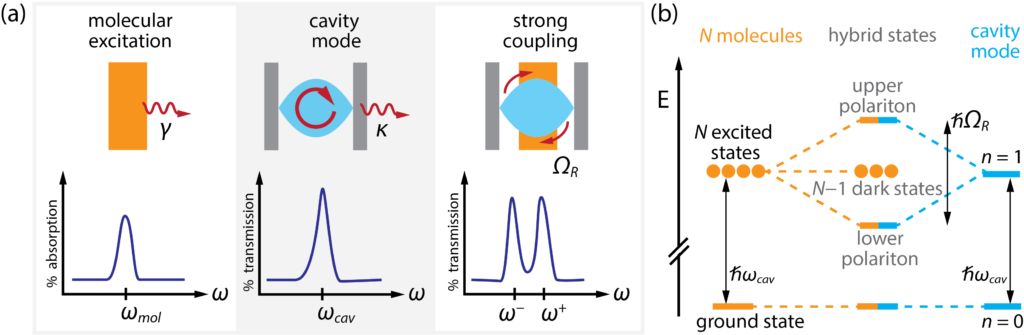
The emerging field of polariton chemistry may provide a new architecture for photonic control of molecular reactivity harnessing strong light-matter interactions engineered in optical cavities. Polaritons are mixed light-matter states that arise when the confined electromagnetic field of an optical cavity interacts strongly with a bright transition of a molecular ensemble. A considerable body of experimental and theoretical work appears to indicate that strong coupling can alter intracavity molecular processes without external illumination. However, the mechanisms underlying cavity-altered chemistry remain unclear in large part because the experimental systems examined previously are too complex for detailed analysis of their reaction dynamics.
Our lab is carrying out new experiments to establish a clear, detailed picture of how molecules behave under strong light-matter interactions. These problems demand surveys of computationally-tractable, strongly-coupled reactions with experimental methods that can directly track the time-dependent populations of reactants, transient intermediates, and products in specific quantum states. We use both ultrafast and high-resolution spectroscopic methods to follow the trajectories of benchmark condensed-phase and gas-phase molecular processes under strong coupling. We are also very interested in using classical optics as an analytical and interpretive tool for the linear and nonlinear spectroscopy of polaritonic systems.
Current Project Members
Condensed-phase spectroscopy and dynamics: Alexander McKillop, Ezra Korican-Barlay, Bailey Nebgen
Gas-phase spectroscopy and dynamics: Jane Nelson, Neo Lin, Maddie Rohde
Recent Publications
- A. M. McKillop, M. L. Weichman. Nonlinear signal enhancement of strongly-coupled molecules in pump-probe experiments. arXiv 2604.05261 (2026).
- J. C. Nelson, T. H. Wright, N. Lin, M. Rohde, M. L. Weichman. Electronic strong coupling of gas-phase molecular iodine. arXiv 2602.09243 (2026).
- A. M. McKillop, L. Chen, A. P. Fidler, and M. L. Weichman. Direct readout of excited state lifetimes in chlorin chromophores under electronic strong coupling. J. Am. Chem. Soc. 148, 9, 9737 (2026).
- L. Chen, A. M. McKillop, A. P. Fidler, and M. L. Weichman. Ultrafast optical modulation of vibrational strong coupling in ReCl(CO)3(2,2-bipyridine). Nanophotonics 14, 5437 (2025).
- A. M. McKillop and M. L. Weichman. A cavity-enhanced spectroscopist’s lens on molecular polaritons. Chem. Phys. Rev. 6, 031308 (2025).
- J. C. Nelson and M. L. Weichman. More than just smoke and mirrors: Gas-phase polaritons for optical control of chemistry. J. Chem. Phys. 161, 074304 (2024).
- L. Chen, A. P. Fidler, A. M. McKillop, and M. L. Weichman. Exploring the impact of vibrational cavity coupling strength on ultrafast CN + c-C6H12 reaction dynamics. Nanophotonics 13, 2591 (2024).
- A. D. Wright, J. C. Nelson, M. L. Weichman. A versatile platform for gas-phase molecular polaritonics. J. Chem. Phys. 159, 164202 (2023).
- A. P. Fidler, L. Chen, A. M. McKillop, M. L. Weichman. Ultrafast dynamics of CN radical reactions with chloroform solvent under vibrational strong coupling. J. Chem. Phys. 159, 164302 (2023).
- A. D. Wright, J. C. Nelson, M. L. Weichman. Rovibrational polaritons in gas-phase methane. J. Am. Chem. Soc. 145, 5982 (2023).